Friday, September 23, 2011

Some Where Over the Rainbow


Somewhere, over the rainbow, way up high.
There's a land that I heard of Once in a lullaby.
Somewhere, over the rainbow, skies are blue.
And the dreams that you dare to dream
Really do come true.
Someday I'll wish upon a star and wake up where the clouds are far Behind me.
Where troubles melt like lemon drops, Away above the chimney tops.
That's where you'll find me.
Somewhere, over the rainbow, bluebirds fly. Birds fly over the rainbow,
Why then - oh, why can't I?
If happy little bluebirds fly beyond the rainbow,
Why, oh, why can't I?

-The Wizard of Oz

Wednesday, September 14, 2011

Iar333: The Light Model- Stairway to Heaven


The lighting principles explored in our design are based in a high level or reflective surfaces. The horizontal planes are immersed in a layer of reflective paper meant to diffuse ambient light around the slit apertures while the flow of the light through the center onto the flat surfaces creates accent lighting g. the reflected light from the paper would impact the interior by cascading refracted light on the theoretical water bellow it, illuminating the space. The hidden, ambient glow would provide soft diffused light that would ease strain on the eye from the refracted light and glare of reflective material.


WEEK ONE [people+chair=drawing]

Nikki
Kathrin
Jenni
Casie
Cathryn
Sharon
Carly
Abigail


ME- Kayla


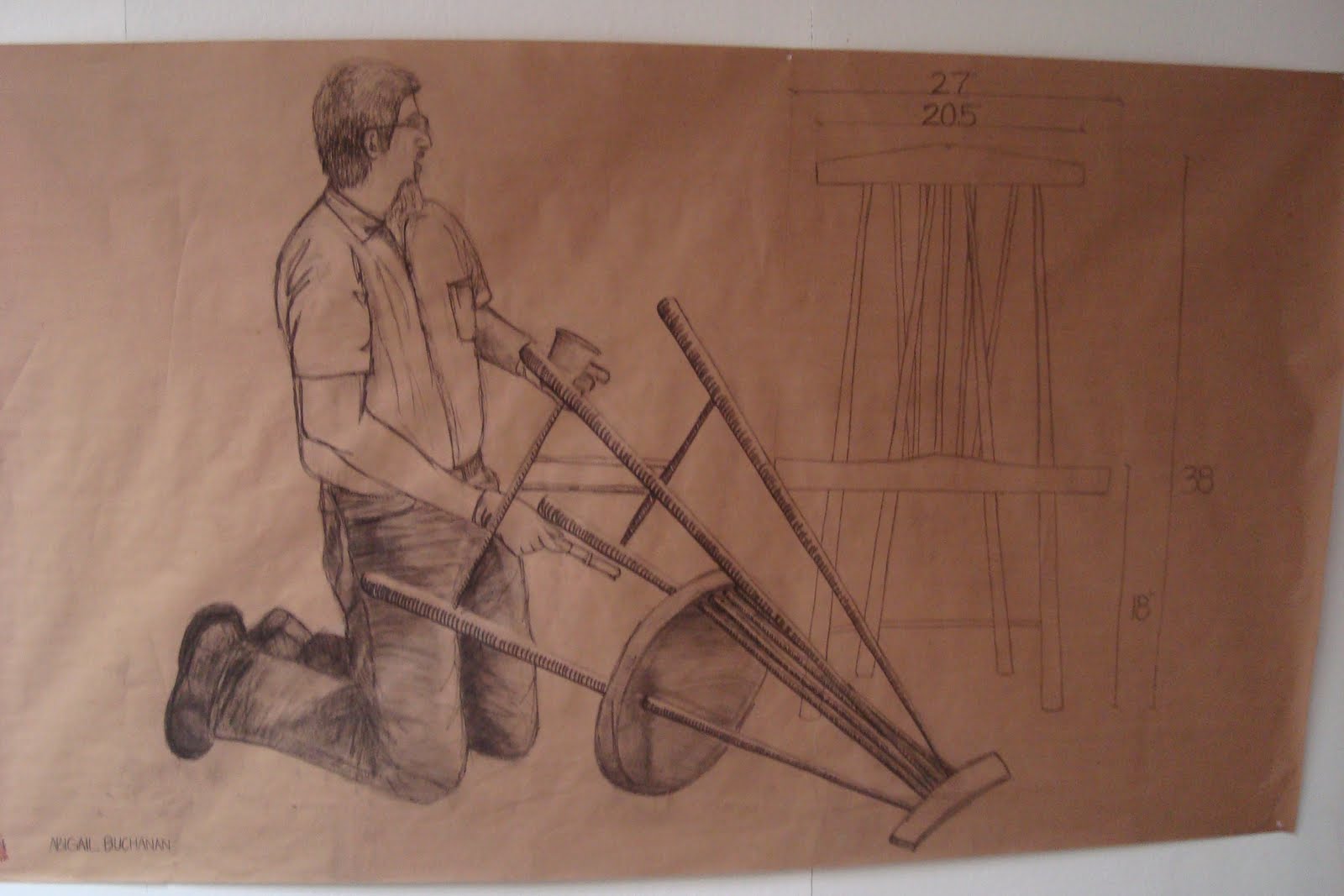
The first project of the semester required my studio mates and I to draw a full scale human and chair in order to depict how chairs relate to the human body. Everyone took very different approaches in order to show the ergonomics of the chair. Some were very technical and realistic while others took a much more artistic approach. Some people even drew Stoel while he painted the chair he designed.

As for my approach I wanted to depict a palimpsest of information. I wanted to draw and "naked woman sitting on a chair", I drew this with very this lines and shaded her in with white to create contrast and have her and the chair stand out the most. Extending from the woman I marked the radius of movement from her arms and legs. In the background I lightly drew a modular man with the standard dimensions of humans.  

Tuesday, August 30, 2011

Iar333: Light Revealing Arcitecture


Light and Place
Light find ways to express different places. It generally expresses the place itself and the places physical feature and characteristics that determine how it differs from any other place as well as how the place changes over time. Light changes depending on its location and variation of time and thee changing cycle of the seasons. Climate also takes a toll on how climate is perceived in a place and it causes people to feel different emotions when experience the place. The circadian rhythm for each individual is influence as specific places retain their own identity within the general region. Not only do region influences people, the daily rhythm of light strongly shapes peoples habits and rituals. This being said, “Each place, each prospect from a place, is defines uniquely due to the myriad combinations that reveal it in light. This light shapes both the prospect from the building and also the light that enters the building.” (Light Revealing Architecture, Pg. 8). The genius loci also known as the spirit of a place can be experienced by responding sensitively to its light. The spirit of a place can be manipulated to enhance an experience of a place. This is generally done by manipulating light through reflection, colors, texture, or other qualities. Shadows in different variations can also add beauty to a space. This is seen as a simple way to allow the exploration of light within a place allowing for a natural charm. Considering this, one must take into account the orientation a place because it greatly influences that way light flows into the place. This is important for the comfort or the people experience the place.

Light and Nature
As time progresses and technology evolved we have essentially lost touch with nature. Although this has occurred, nature has a particular way of being part of people’s lives. The light that is portrayed with the natural environment portrays a spirit of a place that can be captured and modified for another place and still keeping its natural spirit and luminous qualities. The qualities of light change the nature of a building using different types of light that are seen within natural environments such as filtered , intense, or weak as well as patterns such as speckled, dabbled, smooth, or wispy and also the direction, color, and relation of light to its surroundings. Many designers are inspired by nature and attempt to bridge the gap of interior and exterior by using the qualities of natural light and also pulling element from nature to influence the spread of light.

Light and Climate
Light and climate greatly impact spaces, it deals with the spirit of a place, with thermal comfort, and also culture since climate affects people, their habits, and their rituals. The color and rhythms of light are related to the genius loci and should always be taken into account when designing a space. Light is used in tow way when dealing with the climate and assisting in the improvement of thermal conditions. Light provides a visual counterpoint within a place softening the harsh reality of an environment helping with extensive hot and cold climates.  It is also a way to allow heat into a place in terms of the psychological connection of heat and light. Light has its ways of transforming uncomfortable realities of a particular condition, this can be as simple as taking into account that lights emit heat, whether it is sunlight or electric light. Keeping this in mind one can change a seemingly cold environment into being warm. The emission or warm sunbeams into an interior on a frigid winter day allows for a sense of energy and glamour within the space. Yet in warmer climates, cooler spaces are much more appealing and comfortable. By simply, presenting the sound of water, it creates a form a “psychological cooling” in order to alleviate the unpleasant condition of the actual climate.  Climate is very importance when dealing with the comfort of people which influence how they react in and to a space.

Light and Time
People are biologically in tune with time, specifically pertaining to light. As the environment constantly changes around us so does light, which changes depending on the time of day or the changing of the seasons, and more so the different characteristic that come with each season.  The constant shifting of light and color show the evolution of this, which is part of our life experiences. This can be revealed within a building by studying the ever shifting shadows on surfaces and the seasons are revealed by the constant changing color of the light. Relying on electric light may dampen the sense of time shifting from light to dark. Electric light differs from sunlight due to sunlight casting shadows into an interior where as in the darkness of the night electric lights spread light into the darkness in order to see.

Light and Task
Light is mostly noticed when there is not enough or when there is too much of it. Is a person is uncomfortable with the light they are working in they tend to pay more intention to the problematic light than the task at hand. Each person has a different need and light lever that they feel more comfortable in. the environment that you are in also require different levels of light depending on the tasks the space is used for. For instance is workspace is generally lit brightly to increase productivity compared to a restaurant which is very dim and intimate. Whatever the task in a specific place may be, light must be carefully considered.

Light and Me
On a day to day basis light influences me. One a good day I wake up with the warmth of sunlight spilling into my room giving me energy to start the day. At the moment that light fade I feel as if my day is done and I become lethargic and not productive at all. I believe this is what the circadian rhythm sums up about our body being on a time schedule depending on the light we experience.

Iar333: Impact of Light on Health and Welfare


As a result of research pertaining to light over the past centuries researchers have discover that light affects the way people behave and perform as well as the importance of light affecting the humans mental and physical health. This being said, the impact of light on humans is important for their health and welfare which means it is crucial to consider when designing a space.

As the body is exposed to different lights it reacts in different ways mostly due to the changing of melatonin level in the body. The receptor cell called ganglion signals the changes of light which synchronizes the brain’s and body’s response to circadian rhythms which is the daily pattern of light in which the body react to brighter light with wakefulness and darkness with sleepiness. When being subject to electric light, it influenced the natural circadian rhythm preexisting in the body. As far as I have understood having a regular and natural circadian rhythm is much more beneficial to one’s health and welfare.

During the wonder month the days are shorter therefor the body react to this. In several studies it showed that a person’s body clock is regulated mainly by natural light emitted from the sun rather than a clock. Since the body is regulated by the ganglion then the increase of darkness during the winter months affect our body by making us sleepy and less energetic, also because of the colder weather people tend to stay indoors and are not exposed to sufficient levels of sunlight. This is associated with Seasonal Affective Disorder (SAD) which involves episodes of depression that occur every year during fall or winter.

Personal relation:

During the winter the days are much shorter making me feel slower and less energetic. During this time I am generally at school staying indoors without obtaining much sunlight. This year it resulted in me being vitamin D deficient. The difficult part about this situation is that I do not have the choice of going outdoors to obtain sunlight I am too busy with school work (which would be difficult to accomplish outside of studio.

Thursday, April 21, 2011

PROJECTion


This is the shadow silhouette I’ve chosen. I chose it because a common hand shadow is the bird shape and this is obviously a much more realistic image of a bird and being able to manipulate a shadow to make something realistic and recognizable is a main point in my project.

 
PROJECT DOCUMENT
 
Summary

Light is a very important part of design. It can significantly shape a space, but what is not in the light is in the shadows and shadows have a significant impact in a space. Shadows are generally seen as a projection on to a solid where existing perceptions are followed with clear boundaries. As a way to look past the preconceptions of what shadows should look like, the exercise will be undertaken to create an abstract sculpture using pieces of the previous projects from this semester in order to answer the question of how the shadow redefines the space. Using a fixed light source within an interior space, create a definable shadow that is distinctively recognizable by people.

Goals

  • To create a sculpture that does not have immediate resemblance to its shadow.
  • To make people wonder why the shadow that is cast does not look like the sculpture.
  • Discover how one can manipulate a light to create a shadow.
  • Learn how solid objects can be placed in order to impact negative space as well as a solid mass that light cannot penetrate.
  • Stimulate creativity.
  • Use some aspect of any project created this semester.
  • Use the CNC to cut out pieces of the sculpture
  • Make a stop motion video.
  • Document all process work in a booklet.
  • Engage in final product quickly- work with one model.
  • Play with people’s perception with projection
  • To “PRODUCE”
  • To enjoy the project

Objectives

  • To manipulate a material to create a sculpture that has a specific shadow to learn how to manipulate solids so that the shadows cast are intentional in form, to develop a better understanding of how to create a specific shadows.
  • To create a conversation between what people think they should see and what they actually see or conception versus perception.
  • To create an understanding that things are not always as they seem.
  • To be able to use shadows as a way to create interest in a space.
  • Learn through trial and error.
  • Create a shadow image entirely different to what is seen when looking directly at the deliberately placed wood pieces
Stages

o   Part 1: precedent study, find silhouette for shadow
o   Part 2: choose location, get light source and camera.
o   Part 3: create cut file for CNC, cut out parts of model
o   Part 4: Create sculpture- scale: whatever is necessary, you discover it.
o   Part 5: assemble process into a booklet and stop motion video.

Timeline

o   Part1- Friday, April 8
o   Part2- Monday, April 11
o   Part3-Wednesday, April 13th ( depends on Jonathon’s schedule)
o   Part4- Wednesday, April 20
o   Part5- Thursday, April 21

Deliverables

  • Stop motion video
  • Process booklet
  • Process model of sculpture with fixed light source. Does not have to be present at critique.
  • Project document
Presentation parameters

  • State project, pass out project brief.
  • Present final sculpture (how is up to you), process booklet, stop motion video.
  • The order of what you present is based on how you believe your project should be presented.
  • All things presented must be understood without having to talk, but for the purpose of this presentation talking is permitted. Be prepared to answer questions. Formal attire is required, one should look proud to stand by their work.
Grading rubric

10-Precedents- what information have you taken from the precedent and put towards your project
20-Video shows process
20-Sculpture and shadow not immediately visually linked.
20-shadow should be recognizable
20- Process booklet must be well crafted and show process of the entire project as well as the writings you thought were necessary
10-Presentation- clarity of speech, dressed presentable, confident in your own work, attempts to answer all question to the best of knowledge, does not get defensive during constructive criticism

100- Total points